
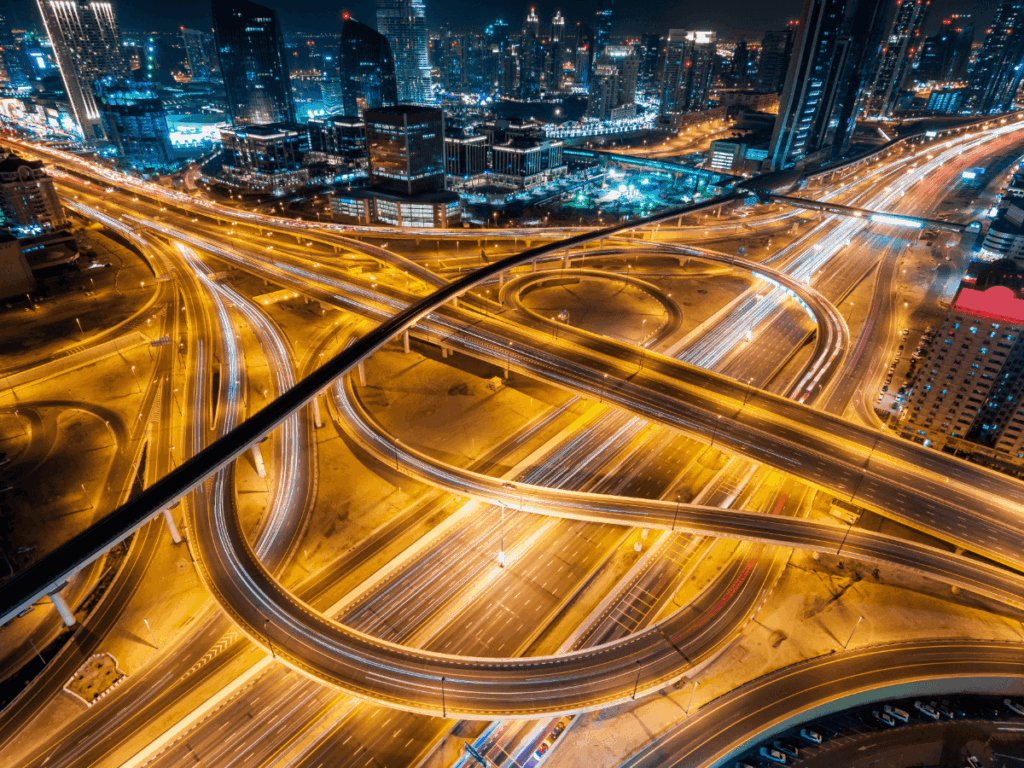
Dubai is at the beginning of a revolutionary new way of getting around, and it is going to completely change the way we get around in Dubai and the entire UAE. In addition to new roads, there will be investments in rail systems, commercial flying taxis, upgraded Dubai Metro and new Artificial Intelligence (AI) public transport systems. In the future, e-mobility will provide a faster, smarter, greener and more seamless solution for our daily commutes.
All of the following initiatives aim to develop a better method for getting around by reducing congestion and re-envisioning the urban travel experience: wider highways, high-speed rail, smart streets, and Dubai’s innovative vision for developing a ’20-Minute City’. By 2030, Dubai‘s transportation ecosystem will be one of the most advanced in the world with unprecedented levels of innovation, sustainability and connectivity.
1. Dh170 Billion National Road Network Upgrade
Emirates Road – Expansion of the road to include an additional ten lanes, a 65% increase in capacity and a 45% reduction in travel times.
Sheikh Mohammed bin Zayed Road – Expansion to include an additional ten lanes, a 45% increase in capacity.
Etihad Road – Added six additional lanes to the existing road (three additional lanes in each direction), which resulted in a 60% increase in total capacity.
As a result of these improvements, travel between the Emirates will be greatly enhanced and the long distance traffic networks will experience a marked reduction in congestion.
2. Dubai Loop: Elon Musk’s High-Speed Underground Network
Dubai Loop in Dubai, and is targeting a completion date for the first phase in the second quarter of 2026. The Dubai Loop will represent The Boring Company’s first construction project in the Middle East.
As an underground tunnel, the Dubai Loop will link all major districts in Dubai via an underground transport system that will offer secure transportation that is weather-resistant, free from traffic congestion, and ground–based methods of transportation.
Musk compares the experience of travelling through the Dubai Loop to “travelling through a wormhole.” In Musk’s opinion, tunnels can be considerably faster than other methods of transporting people, as well as being extremely safe – “It’s like being in a submarine while facing a storm.“
3. Flying Taxis to Launch by 2026
Dubai is poised to be the world’s first city to implement a fully operational air taxi service. The Service will not be a trial run but a fully functioning transportation method. In 2024, Joby Aviation obtained a contract from Dubai’s RTA for six years which provides exclusivity to operate this Service of electric vertical take-off and landing (eVTOL) vehicles which can:
– Transport four passengers and a pilot
– Travel 200 kilometers
– Achieve speeds of over 300 km/h
As a result, a connection between the cities of Dubai and Abu Dhabi, Ras Al Khaimah, or Fujairah could take less than 30 minutes. Plans for the construction of the first vertiport at Dubai International Airport are currently underway.
4. Etihad Rail Passenger Services by 2026
Exciting developments have been taking place as the UAE continues to develop their National Rail Network and they are projected to begin offering passenger service to travelers by 2026. The Etihad Rail service will be a fast and comfortable alternative mode of transportation compared to traveling by auto on the expressway. Each train will seat up to 400 passengers and run multiple times each day.
Estimated travel times to/from the various emirates will be as follows:
Abu Dhabi – Dubai: 57 minutes
Abu Dhabi – Fujairah: 105 minutes
Abu Dhabi – Ruwais: 70 minutes
The planned high-speed rail service from Abu Dhabi to Dubai is being developed with the intent to reduce that travel time to only 30 minutes with the potential of reaching speeds up to 350 km/hour.
The Etihad Rail Service is expected to help alleviate traffic congestion on the roadways while improving travel between emirates and will result in a reduction of carbon emissions for those who choose to travel via rail.
5. Dubai Metro Blue Line: Major Expansion for 2030
The upcoming Blue line is going to enhance Metro coverage and reduce traffic congestion greatly.
There are two major routes:
–21 km from Al Khor through to Academic City (10 stations)
–9 km from Centrepoint through to International City (4 stations)
The line will connect with the existing Red & Green lines, link to Dubai International Airport, and will help the city eliminate at least 20% of its vehicular congestion. Expect train service every two minutes means:
– 200,000 riders per day in 2030
– 320,000 riders per day in 2040
6. Major Road Improvements Across Dubai
The main upgrades include:
Trade Centre Roundabout – Travel time reduced from 6 minutes to 1 minute
Al Mustaqbal Street – Travel time reduced from 13 minutes to 6 minutes
Al Qudra Street – Travel time reduced from 9.4 minutes to 2.8 minutes; capacity increased 300%
Oud Metha + Al Asayel Streets – Travel time reduced from 20 minutes to 5 minutes
Umm Suqeim Street – Travel time reduced by 61% (9.7 minutes to 3.8 minutes)
These upgrades create new opportunities for travel, thus relieving congestion on some of the busiest road networks in Dubai.
7. Smart Traffic: Vehicles Talking to Traffic Lights
In the coming years, Dubai is working on AIMobility with its V2X (Vehicle to Everything) technology. It is expected that this technology will launch within 2027–2028 and will enable vehicles to communicate directly with traffic lights in real–time.
With the implementation of AI, sensors, and DNAT(s) (Digital twin design), the V2X system will provide several benefits, including:
1 – optimizing traffic flow
2 – reducing congestion
3 – enhancing safety
4 – very quickly adjusting signal times.
This represents a huge leap forward toward fully automated transportation solutions.
8. Dubai’s New Trackless Tram
Some important characteristics of these inventive Trams:
Capable of transporting up to 300 passengers
Maximum speed is 70 km/h
Range is 100 km per charge
Users can easily integrate their travel with the Metro and Tram services within the Dubai Public Transportation system
The introduction of a well-designed Trackless Tram system into the existing public transportation network will provide an environmentally friendly option for the public.
9. Dubai’s 20-Minute City Vision
The City of Dubai intends to develop into a sustainable City by providing all of residents’ daily requirements by means of a public transportation system within a 20-minute service area.
In two decades, the public transportation investment of Metro, Bus and the road infrastructure has transformed the City into one of the most connected cities in the world.
The McKinsey report revealed:
Transport revenues of Dh150 billion.
Time and fuel savings to the City of Dh319 billion.
The addition of Dh156 billion to the GRP of Dubai.
A rise in property values of 16% (Dh158 billion).
The development vision for the City of Dubai will continue to promote smart urban development, sustainable growth and first-class mobility.
Also Read: New Bridge to Ease Traffic and Connect Bur Dubai with Dubai Islands